Surface 118-02
209
4
Medium:
Wall
Material:
Plaster
The documentation and processing of the surface was carried out in 2024 and 2025 by an international team; Gunnar Almevik, Jonathan Westin, and Ashely Green (University of Gothenburg, Sweden), Alexander Ganshin, Sviatoslav Petryk, Oksana Kovalska, and Sergii Trofymchuk (National Conservation Area “St. Sophia of Kyiv”, Ukraine), and Lucie Urbanová (Czech Republic).
Inscription 118-02:117 (149)
Type:
Textual graffiti
Genre:
Commemoration
Language:
Church Slavonic
Writing system:
Cyrillic
Textual Graffiti
Plain
Epidoc
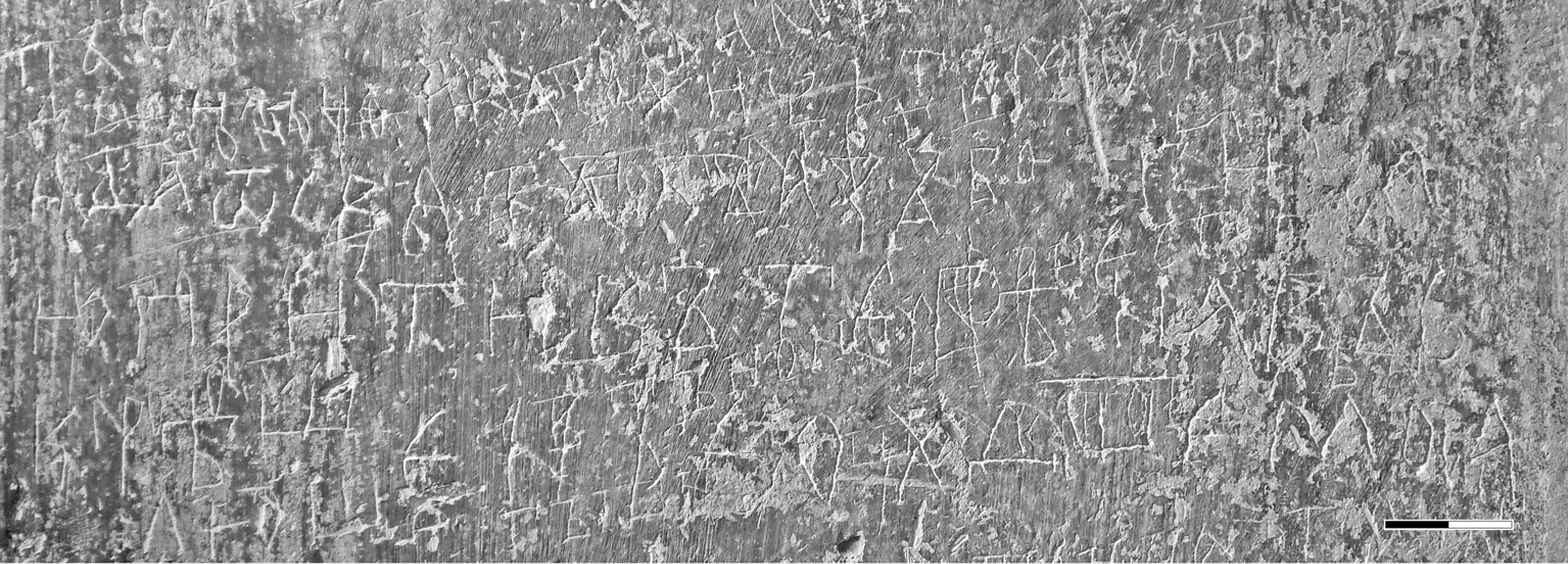
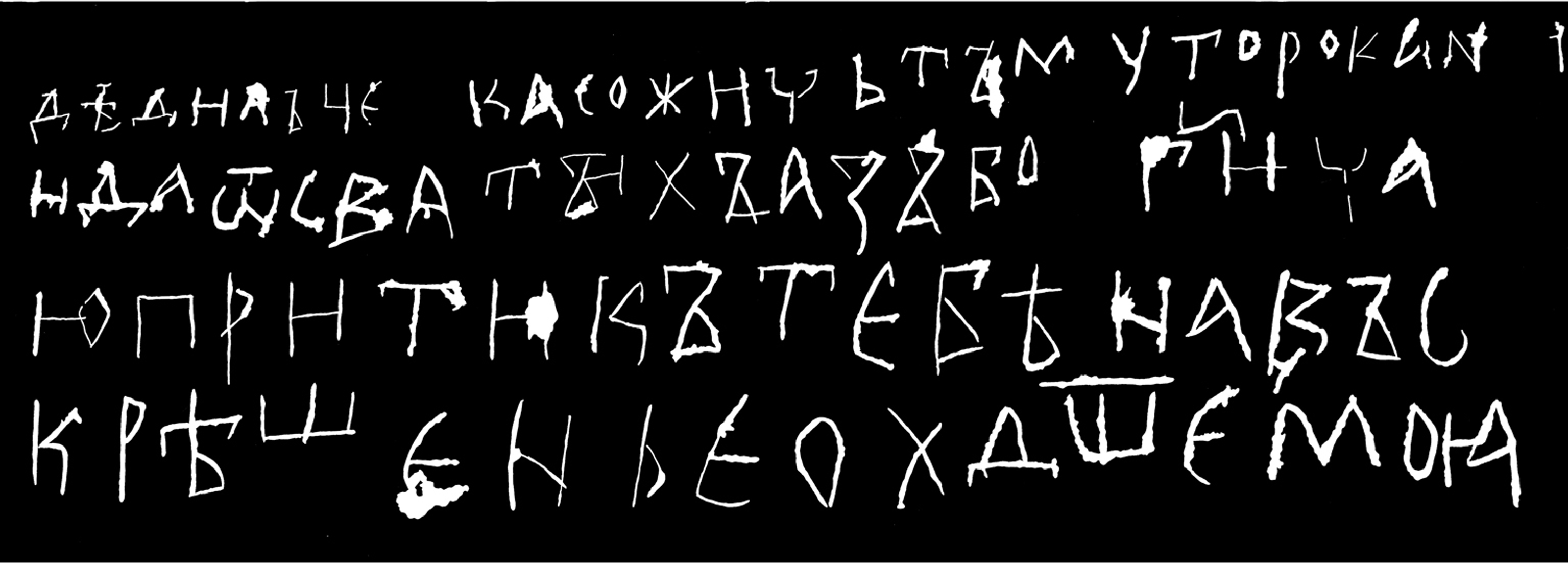
дѣдлъцекасожичьтъмуторокан--|
даѿсвѧтхъаꙁъбог͠ча|юпрткътебѣнавъс|крѣшеньеохдш͠ емоꙗ
Interpretative edition
Plain
Epidoc
Дѣдилъце касожичь тмуторокан[ьць ѱ(алъ)] ида ѿ свѧтыхъ азъ бо Г(оспод)и чаю прити къ Тебѣ на въскрѣшенье ох д(оу)ше моꙗ.
Romanisation
Dědilʺce kasožičʹ tmuтorokan[ʹcʹ ѱ(alʺ)] ida ѿ svâtyхʺ azʺ bo G(ospod)i čaû priti kʺ Tebě na vʺskrěšenʹe oh d(ou)še moâ.
Translation
Dediltse, a Kasog from Tmutorokan, wrote this while returning from the holy places. For I, O Lord, hope to come to You at the resurrection. Oh, my soul.
Condition:
Broken
Alignment:
Inclinating
Elevation (mm)
1740
Dating:
1050 - 1115
Dating Criteria:
Context, Paleography
Comments
The preservation of the inscription is good, and the text is clearly legible:
дѣдлъ[1]це[2]касожичьтъм[3]ут[4]орокан[5]---[6] |
даѿсвѧтхъаꙁъбог͠ча|юпрткътебѣнавъс|крѣшень[7]еохдш͠ емоꙗ
1. Both scholars read this letter as ь, but on the surface of the fresco it is clearly read as ъ.
2. S. Vysotsky identified the letter ц as и, but it is clearly identifiable as ц (A. Zaliznyak). V. Nimchuk, on the other hand, identified it as н, and after е indicated the presence of a non-existent letter с.
3. A. Zaliznyak indicated that at this point the letter о — a component of the digraph оу — was destroyed by a vertical scratch, but there are no fragments of о on either side of the scratch on the fresco plaster.
4. S. Vysotsky erroneously identified this letter as п.
5. During publication, S. Vysotsky omitted the end of this line. A. Zaliznyak, working from a photograph, was able to read the syllables ро, which he believed were fully preserved, and ка, which were preserved fragmentarily. Here there are five well-preserved letters рокан. V. Nimchuk saw the syllable по here.
6. At this point, A. Zaliznyak reconstructs the letters ьцьѱлъ or ьцьѱ; the latter is the most probable.
7. Both scholars identified this letter as и, but on the fresco it is clearly read as ь.
S. Vysotsky believed that the inscription was made by a Kasog Christian who had lived for a long time in the lands of Rus', where he had learned to write and read. These conclusions were partially accepted and developed by other scholars.
V. Chkhaidze and I. Druzhinina regarded the inscription as important evidence of the process of Christianization of the Kasogs at the end of the 11th – beginning of the 12th century; the researchers cite as a reinforcing argument for this thesis the circumstance that the text vividly reveals Dedilts's deep and sincere acceptance of the Christian faith, as well as the fact of his pilgrimage to the holy sites of Kyiv (V.N. Chkhaidze, I.A. Druzhinina, Graffiti iz Sofii Kievskoi – svidetel'stvo khristianizatsii kasogov v kontse XI – nachale XII vv., Materialy i issledovaniia po arkheologii severnogo Kavkaza 5 (Armavir 2005) 155–158.).
O. Bubenok is inclined to see in this inscription evidence of the resettlement of already Christianized Kasogs from Tmutorokan to Kyiv or other territories of Rus'-Ukraine in the 11th century; in support of this thesis, the researcher cites Dedilts's good knowledge of Church Slavonic, as well as the fact that he bears a Slavic name. For this reason, O. Bubenok considers Dedilts to be a descendant of Kasog Christians resettled from Tmutorokan to Kyiv in the 11th century, who, moreover, was born and raised either in Kyiv or in some other city of the principality, but not in Tmutorokan (O.B. Bubenok, Kasogi v Kieve, Vestnik Kabardino-Balkarskogo instituta gumanitarnykh issledovanii 3(26) (Nalchik 2015) 12–15.).
Acknowledging Dedilts's origin from Tmutorokan and his ethnic affiliation with the Kasogs, V. Franchuk proposes to identify the author of the graffito with the Ryazan boyar Dedilts mentioned in chronicle records under the years 1175 and 1177, who was taken prisoner by the Vladimir prince Vsevolod Yuryevich after the defeat of the Ryazan prince Gleb (Polnoe sobranie russkikh letopisei, t. 2: Ipat'evskaia letopis', 2-e izd., Moskva 2001, stlb. 595; Polnoe sobranie russkikh letopisei, t. X: Letopisnyi sbornik, imenuemyi Patriarshei ili Nikonovskoi letopis'iu / S pril. izvlechenii iz monografii B.M. Klossa "Nikonovskii svod i russkie letopisi XVI–XVII vekov", Moskva 2000, s. 5.). According to the researcher, after his release from captivity, this boyar left his prayerful address to the Lord as a sign of gratitude for his freedom. Subsequently, he continued his service under the Chernihiv princes (V.Yu. Franchuk, Inoplemennniki v strukture gosudarstvennoi vlasti Rusi XII v., Vostochnaia Evropa v drevnosti i srednevekov'e. Gosudarstvennaia territoriia kak faktor politogeneza. XXVII chteniia pamiati chlena-korr. AN SSSR V.T. Pashuto, Moskva, 15–17 aprelia 2015 g., Materialy konferentsii, Moskva 2015, s. 292.). However, V. Franchuk's version does not correspond to the chronology of the inscription, which is dated to the second half of the 11th century, while the Ryazan boyar Dedilts participated in the internecine conflicts of the 1170s, and we can safely dismiss it. For even if one were to assume that Dedilts made the graffito not after his release from captivity but somewhere at the dawn of his youth, he would hardly have been full of strength and energy to participate in princely quarrels at the age of over eighty. All the more so since the Ryazan boyar was not the only bearer of this name; as an example, one may cite birchbark document No. 6 from Staraya Russa, dating to the mid-12th century, in which a person named Dedilo is mentioned (A.A. Zaliznyak, Drevnenovgorodskii dialekt. 2-e izdanie, pererabotannoe s uchetom materiala nakhodok 1995–2003 gg., Moskva 2004, s. 329–330.).
The versions of other researchers, which at first glance appear entirely logical, nonetheless contain a number of contradictions that deserve examination below.
First of all, attention is drawn to the fact that Dedilts calls himself a Tmutorokanets. On the basis of the palaeographic dating of the graffito, as well as the height of its placement on the fresco — which indicates that it was made by an adult — it can be established that Dedilts was born approximately in the second or third quarter of the 11th century, that is, precisely at the time when Tmutorokan was part of Rus'-Ukraine, remaining within the sphere of influence of the Chernihiv, and subsequently the Kyiv, princes (For details, see: V.N. Chkhaidze, Tmutarakan' – vladenie Drevnerusskogo gosudarstva v 80-e gg. X – 90-e gg. XI vekov, Vestnik Moskovskogo gorodskogo pedagogicheskogo universiteta, Nauchnyi zhurnal, seriia "Istoricheskie nauki" 1(5) (2010) 20–37.). The author's use of the identifying noun тмутороканьць indicates that he was born or lived for a long time in this Black Sea city, since this noun would be entirely inappropriate if Dedilts had been born and lived in some settlement of the Kyiv, Chernihiv, or another principality. Therefore, O. Bubenok's version about Dedilts being born in Kyiv or in the Kyiv principality in the family of resettled Kasog Christians lacks sufficient argumentation. All the more so since Dedilts himself indicated in the text that he did not reside in Kyiv: apart from the noun "Tmutorokanets," this is also indicated by the use of the verb ида rather than пришьдъ, as was noted by previous publishers of the inscription (S.A. Vysotsky, Srednevekovye nadpisi Sofii Kievskoi, p. 56; A.A. Zaliznyak, K izucheniiu drevnerusskikh nadpisei, p. 257.).
As for the second identifying noun, which defines Dedilts's ethnic affiliation — касожичь — it is most plausibly understood as a derivative with the suffix -ичь used to denote a person's origin from tribal, ethnic, or local designations (вѧтичь, кривичь, нѣмьчичь, русичь, etc.) (See: A.A. Zaliznyak, K izucheniiu drevnerusskikh nadpisei, p. 257.). That is, Dedilts was a Kasog, although in the inscription he calls himself not by a Kasog but by a Slavic pagan name. It is therefore objectively worth clarifying how an ethnic Kasog could have received it.
Researchers paid no significant attention to resolving this question. A. Zaliznyak offered a possible explanation in the fact that Dedilts was born of a mixed marriage between a Kasog father and a Slavic mother (Admittedly, he did not write about this directly, but the presentation of interpretive options for the name and byname (or patronymic) "kasоzhich" reveals precisely this thought on the author's part: A.A. Zaliznyak, K izucheniiu drevnerusskikh nadpisei, p. 257.). This interpretation was cited without particular argumentation by O. Bubenok (O.B. Bubenok, Kasogi v Kieve, p. 15.), since it accorded well with the version of Dedilts as a descendant of Kasog Christians resettled to Kyiv. Other researchers also mentioned A. Zaliznyak's arguments but offered no explanation of them.
Equally, in the works of the graffito's publishers, no logical explanation was found for the discrepancy between Dedilts's clearly visible Christian zeal and his use of a secular non-Christian name. A. Zaliznyak noted that this occurred due to his relatively recent baptism, so that Dedilts had not yet developed the habit of "identifying himself in matters of faith by his baptismal name" (A.A. Zaliznyak, K izucheniiu drevnerusskikh nadpisei, p. 257.).
Also passed over were the possible circumstances of Dedilts's acquisition of Church Slavonic literacy, since the inscription contains no errors or deviations from the written norm of the time. The features of the formulaic part of the text indicate that it was composed by Dedilts himself, so the assumption that the inscription was made by a third party — and hence the possible illiteracy of Dedilts — has no foundation. V. Chkhaidze inclines to the view that he learned literacy in Tmutorokan as a parishioner of a Rus' church (V.N. Chkhaidze, Tmutarakan' – vladenie Drevnerusskogo gosudarstva, p. 25.). S. Vysotsky, and following him O. Bubenok, believe that he acquired literacy in the lands of Rus', where he lived for a long time or was born (S.A. Vysotsky, Srednevekovye nadpisi Sofii Kievskoi, p. 56; O.B. Bubenok, Kasogi v Kieve, p. 14.).
As we can see, in all cases the researchers took their own conception of Dedilts's biography as their starting point, and from there attempted to outline individual milestones of his life. All the more so since the publishers' commentaries, with their range of possible interpretations, defined a broad field for selecting whichever of them corresponded to the proposed conceptions of the Christianization of the Kasogs, their resettlement to the lands of Rus'-Ukraine, and the identification of epigraphic and chronicle records. If, on the other hand, one proceeds from the text of the inscription itself, placing it in its historical and comparative context, the contradictions can be resolved with a high degree of probability. Studies of medieval onomastics indicate that in those times a person could bear several names during their lifetime, which were perceived as equivalent. Moreover, changes in a person's name during their lifetime were quite common (For details, see, e.g.: I.S. Filippov, Kreshchenie yazycheskim imenem i drugie paradoksy zapadnoevropeiskoi antroponimii v rannem srednevekov'e, Imenoslov. Istoricheskaia semantika imeni, vyp. 2, Moskva 2007, s. 88–115.). This could occur in connection with baptism, if the person was of a different faith. Also upon taking holy orders or monastic tonsure. A name could change as a result of a change in region or country of residence, when a person received an anthroponym characteristic of that environment. It was also not uncommon for a person to become better known in society by a nickname, under which they might appear even in official documents. However, Dedilts is hardly a nickname of the author's, since it is, in fact, a Slavic pagan name (See: N.M. Tupikov, Slovar' drevnerusskikh lichnykh sobstvennykh imen, Sankt-Peterburg 1903, s. 141.). The possibility of Dedilts receiving a Slavic name at baptism appears unlikely. Of course, the possibility of baptism with a non-calendar name existed in the Western European Christian tradition (See: I.S. Filippov, Op.cit., s. 88–115.), but such a practice found no support among the Byzantine clergy, being mentioned as one of the charges against the Western Church in anti-Catholic polemic; similar accusations were also voiced by the Kyiv metropolitans (I.S. Chichurov, Antilatinsky traktat kievskogo mitropolita Efrema (ok. 1054/55–1061/62 gg.) v sostave grecheskogo kanonicheskogo sbornika Vat. Gr. 828, Vestnik Pravoslavnogo Sviato-Tikhonovskogo gumanitarnogo universiteta. Seriia 1: Bogoslovie. Filosofiia. Religiovedenie 3(19) (2007) 125–127.). In this context, it is worth distinguishing between the tradition of baptism with a pagan name and the tradition of pagan-Christian dual naming in the lands of Rus'-Ukraine, where alongside a person's baptismal calendar name, non-calendar pagan names were frequently used. Indeed, in a number of cases it was precisely the pagan names that predominated in written sources, especially in the princely milieu, since it was the family names that fixed the status of their bearers within the system of dynastic relations (For detailed examples, see: A.F. Litvina, F.B. Uspenskii, Vybor imeni u russkikh kniazei v X–XVI vv.: Dinasticheskaia istoriia skvoz' prizmu antroponimiki, Moskva 2006, s. 118 et al.). At the same time, however, a prince used his Christian anthroponym for his own identification, for example on seals, which depicted the patron saints of princes whose names they received at baptism (See, e.g.: O. Alforov, Molivdovuly kyivskykh kniaziv, s. 16–74.). There are also frequent instances of sources in which pagan and Christian names are indicated simultaneously, as, for example, in the graffito inscription of Bryachislav-Pavel Svyatopolkovich from the central nave of the Cathedral of St. Sophia (For details, see: V.V. Korniienko, Molytovnyi napys Briachyslava Sviatopolkovycha z Sofii Kyivskoi, Pratsi Tsentru pam'iatkoznavstva 18 (2010) 211–217.). That is, pagan names in this case did not replace Christian ones, people were not baptized with them, but they were used as equivalent depending on the circumstances in which their bearer found themselves. Thus, when our Kasog received baptism, he was given a Christian name present in the calendar of saints. This name remained unknown, since the author of the graffito wrote his more familiar pagan name Dedilts. Its use in a respectable Christian text on the fresco of the Cathedral of St. Sophia of Kyiv in no way reveals the depth of the author's belief or unbelief, since at that time Christian and pagan anthroponyms were used as equivalent, even in clerical circles. A vivid example of such equivalence is the name of the Caves monk, the blessed hieromartyr John, known more widely by his pagan name Kuksha (See: Pateryk Kyievo-Pecherskyi, uporiadkuvala, adaptuvala ukrainskoiu movoiu, sklala prymitky ta dodatky Iryna Zhylenko, K. 1998, s. 249.).
That is, the historical context of the tradition of medieval anthroponymics in Rus'-Ukraine contradicts the possibility of Dedilts receiving this pagan name through baptism, just as it contradicts his receiving it upon taking holy orders or monastic tonsure, since in such a case the graffito would nonetheless contain a calendar Christian name. It should be noted, however, that from the available text it is impossible to establish the author's social background. It seems more probable to me that he was nonetheless a layperson, but it is difficult to adduce sufficient arguments either in favor of or against this assumption.
Thus, the only logical explanation for the fact of a Kasog receiving a Slavic name would be the condition of his residing in a social environment in which such names were natural.
In the period from the second quarter to the end of the 11th century, when a Kasog could have entered this social environment, the assumption of a conditional "Slavicization" of the Kasogs in Tmutorokan would appear logical at first glance. First, Dedilts calls himself тмутороканьць, and therefore could have been born or lived for a long time in that city. Second, during the period in question, this Black Sea city was part of Rus'-Ukraine, and it was home to princes or governors, their Rus' entourage, and Rus' clergy (V.N. Chkhaidze, Tmutarakan' – vladenie Drevnerusskogo gosudarstva, s. 26–30.). It is precisely from this perspective that V. Chkhaidze allowed that the Tmutorokan Kasogs could not only have acquired the Rus' language and literacy there, but also have been parishioners of Rus' Orthodox parishes (He does note, however, that the versions concerning the spread of Christianity among the peoples of the Caucasus by "Tmutorokan Rus'" and the interference of the prince-governors of Tmutorokan in the affairs of the Zikhi eparchy do not withstand scrutiny: V.N. Chkhaidze, Tmutarakan' – vladenie Drevnerusskogo gosudarstva, s. 25.).
However, the historical context compels us to reject this version. Archaeological investigations of medieval Tmutorokan and its environs have not recorded any significant presence of a Slavic population; instead, Greek (Byzantine) influences were predominant and quite strong in this region (For details, see: V.N. Chkhaidze, Tmutarakan' (80-e gg. X v. – 90 gg. XI v.). Ocherki istoriografii, Materialy i issledovaniia po arkheologii Severnogo Kavkaza 6 (Armavir 2006) 160–161; V.N. Chkhaidze, Tmutarakan' – vladenie Drevnerusskogo gosudarstva, s. 23; V.N. Chkhaidze, Tamatarkha. Rannesrednevekovyi gorod na Tamanskom poluostrove, Moskva 2008, s. 255, 297.). Thus, a Kasog who was born or moved to Tmutorokan would have found himself in an environment of Greek rather than Slavic anthroponymics. Of course, one might suppose that, as a result of Tmutorokan's entry into the orbit of influence of the Rus' princes and the consequent presence of a small but dominant Rus' contingent in the city, a popularization of Slavic names took place (A similar situation was observed, for example, in medieval Spain, where Christians adopted Arab culture, including in anthroponymics: V. Shishmarev, Ocherki po istorii iazykov Ispanii, Moskva; Leningrad 1941, s. 87–88). However, such an assumption lacks a documentary basis; we have no sources that would reliably attest to the spread of Slavic names specifically among the inhabitants of Tmutorokan. Consequently, the Kasog received the Slavic pagan name Dedilts when he resettled in the lands of Rus'-Ukraine. It is not excluded that it was precisely after this resettlement that he accepted Christianity. In this context, we find ourselves in partial agreement with the version of S. Vysotsky and O. Bubenok regarding the Kasog Dedilts's prolonged residence in the Rus' lands. However, it was more probably not in the Kyiv principality but in the Chernihiv principality, which was more closely connected with Tmutorokan. For it was precisely there that toponyms associated with the Kasogs were preserved for some time, attesting to their residence in compact groups — evidently following their resettlement by Prince Mstislav Vladimirovich in the 1020s in the Siverian lands (V.V. Mavrodin, Ocherki istorii Levoberezhnoi Ukrainy (s drevneishikh vremen do vtoroi poloviny XIV veka), [electronic resource], available at: http://www.rulit.me/programRead.php?program_id=309183&page=94.). It was precisely in this Slavic environment that questions of self-identification with one's place of origin and ethnic affiliation remained relevant for the resettled Kasogs, and it is for this reason that Dedilts adds that he is a "Kasog from Tmutorokan." Thus, in terms of his ethnic affiliation, Dedilts was indeed a Kasog, and we have no sufficient grounds for regarding him as a descendant of a mixed Kasog-Rus' marriage. He was born or spent some time in his youth in Tmutorokan — long enough to subsequently remember his origins and call himself a "Tmutorokanets" in the inscription. In the 1020s, under the rule of the Chernihiv prince Mstislav Vladimirovich, he was resettled, together with other members of the Kasog retinue, in the Siverian lands of the Chernihiv principality, most probably in the vicinity of Rylsk, near which Kasog toponyms have been preserved. It was precisely in the surrounding Slavic environment that he received the name Dedilts, which he became accustomed to using in everyday life. Evidently, Dedilts eventually moved either to the center of the principality — Chernihiv — or to one of the towns closer to the area of Kasog settlement in the Siverian land, where he may have accepted Christianity (if this had not occurred earlier) and learned Church Slavonic. In the second half of the 11th century, Dedilts undertook a pilgrimage to the center of the Kyiv metropolitanate, where he left on the walls of the metropolitan's residence a fervent inscription in the form of a paraphrased Creed, which attests to Dedilts's Christian zeal, particularly characteristic of neophytes.
(Vyacheslav Korniienko)
Bibliography
Вячеслав Корнієнко (Viacheslav Korniienko) (2018). Корпус Графіті Софії Київської - Частина VIII: південні внутрішня та зовнішня галереї. Національна академія наук України, Інститут української археографії та джерелознавства ім. М.С. Грушевського, Національний заповідник „Софія Київська”.
Contributors
Viacheslav Korniienko
Korniienko 2018, plate 237
Photograph
CC BY-NC
Korniienko 2018, plate 237
Drawing
CC BY-NC